Mad Movements and the History of Lived Experience Advocacy
Before lived experience experts were recognised as key to mental health research and policy, and before there was greater general awareness of what “Public and Patient Involvement” and service users and lived experience experts can contribute, mad activist movements and survivor groups were fighting for recognition and shared power in decision-making. These groups have been pivotal in shaping the landscape for lived experience, and in influencing mental health reforms, often at deep personal cost.
At GMHAN, we partner with, and celebrate the expertise of these movements, and we acknowledge that contemporary advocates stand on the shoulders of giants.

Standing on the shoulders of giants
•
Standing on the shoulders of giants •
Mad movements’ histories of lived-experience-led advocacy
People with lived and living experience of distress, suffering, madness and psychiatry have organised to speak for themselves for centuries, sometimes collectively called the Mad movements. "Mad" is a term reclaimed from its historically pejorative and discriminatory use towards people deemed mad or mentally ill by psychiatry and society. In 1620, patients of London's Bethlem Hospital petitioned the House of Lords about their conditions. In the 1850s, patients at New York's Utica asylum wrote and edited their own journal, The Opal.
Former patients in England formed the Alleged Lunatics' Friend Society in 1845. The modern Mad movements, though, took shape around 1970. Influenced by the Black, women's and gay liberation movements, ex-patient groups formed in Portland, New York, Boston, San Francisco, Vancouver, Scotland and London. They insisted on self-definition and self-determination, and they named the prejudice they faced "mentalism", an early form of what we now call sanism.
They built the first peer-run drop-in centres and independent publications such as Madness Network News and Phoenix Rising. Judi Chamberlin's On Our Own (1978) made the case for patient-controlled alternatives to the mental health system.
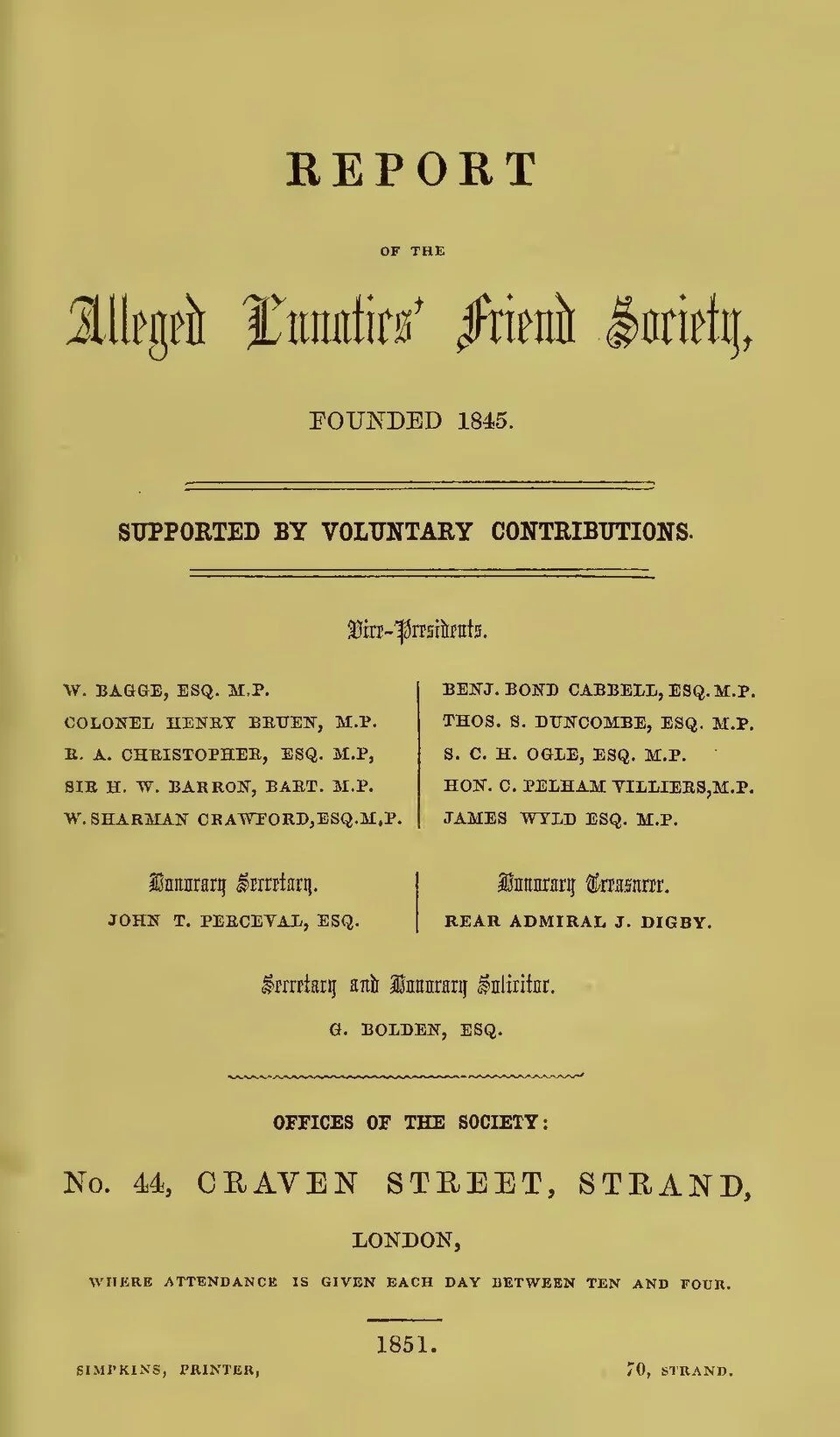
Alleged Lunatics’ Friend Society - 1851 Report
Much of what contemporary mental health advocacy now takes for granted grew from this work. That includes human rights, an emphasis on social and structural determinants, peer support, recovery, lived-experience roles, meaningful engagement frameworks, addressing discrimination, decriminalising suicide, de-institutionalisation, improving housing, employment and welfare conditions, and emphasising the principle of "nothing about us without us".
Yet this history is often uncredited, and it is fragile. Only a handful of archives hold movement records, few, if any of them, in the Global South, and movement luminaries are passing away. They include the late Judi Chamberlin, Mary O'Hagan, Tina Minkowitz, Chris Hansen, David Oaks and the late Dr Bhargavi Davar, whose leadership shaped the movements described here. Recognising these foundations means more than acknowledgement. It means partnering with the representative organisations that carry these traditions today, resourcing their participation, and making sure their priorities shape the agenda rather than only informing it.
These movements went global. In 1991, survivors meeting at the World Federation for Mental Health congress in Mexico founded what became the World Network of Users and Survivors of Psychiatry, first chaired by Mary O'Hagan. Its members helped draft the UN Convention on the Rights of Persons with Disabilities (2006), bringing legal capacity, freedom from coercion and community inclusion into international human-rights law.
In Asia and the Pacific, and then across the Global South, psychosocial disability-led organisations such as Transforming Communities for Inclusion, founded through the work of the late Dr Bhargavi Davar and the Bapu Trust, built regional agendas of their own, from the Bali Declaration to the Addis Declaration. Regional networks in Africa, Europe and Latin America, the Hearing Voices Movement and Mad Pride have each added their own traditions.
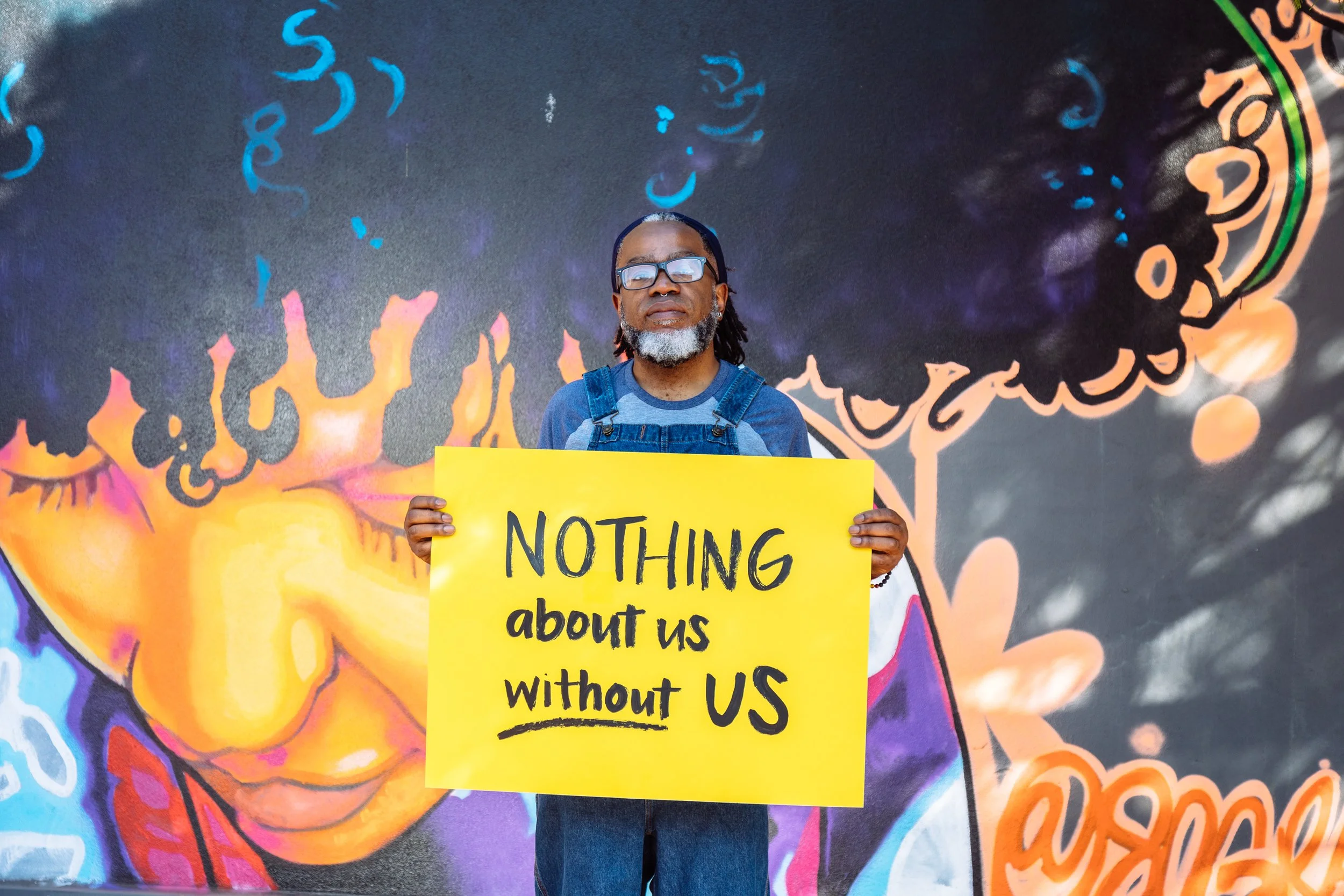
Disabled And Here - Nothing about us without us
Building the Movement
Language: "Mad movements" is an umbrella term. It may refer to user, service user and consumer movements; psychiatric survivor, ex-patient and ex-inmate movements; mental patients' liberation movements, such as the consumer/survivor/ex-patient (c/s/x) movements of the Global North; Mad Pride and Mad movements; psychosocial disability movements, the term used primarily across Global Majority and lived experience movements; and psychosocial diversity, human diversity and mental diversity movements. These movements are connected but not interchangeable, and people and organisations choose their terms deliberately. Many people hold several of these identities at once.
Mad Studies and Mad Pride: Mad Studies grew out of these movements as a field of scholarship, theory and activism grounded in the knowledge of people with lived experience. It now includes dedicated research centres such as the Mad Studies Hub at York University, Toronto, and in 2021 Queen Margaret University, Edinburgh, launched the world's first master's degree in Mad Studies. Mad Pride, which began with the first Psychiatric Survivor Pride Day in Toronto in 1993, celebrates Mad identity, culture and community, and is now marked in many countries around the world.
The World Network of Users and Survivors of Psychiatry
The World Network of Users and Survivors of Psychiatry (WNUSP) is an international organisation representing people with lived experience of psychiatry, often called users, survivors, and ex-patients. WNUSP has played a significant role in changing the international mental health framework from a medical-welfare model to a human rights and legal capacity model at the UN level.
Replay: Breaking Barriers - Reclaiming ‘mad activism’, shifting power and centring lived experience
At this webinar, our expert speakers discussed the crucial role that mad movements and survivor groups have played in shaping “expertise by experience” as we know it. We examined the role of lived experience in shaping the future of mental health policy, practice, science and advocacy, as well as what we need to understand to make this future a reality.
Expert panellists: Grace Gatera, My Mind our Humanity, Wellcome Trust, Rwanda; Parth Sharma, T&F India, India; Chan Li Shan, University of Hawaiʻi at Mānoa, Singapore; Matt Jackman, The Australian Centre for Lived Experience, Australia; Sasha Hajj Assaf, Justice for Lebanon, Lebanon.
-
Chamberlin, J. (1990). The Ex-Patients' Movement: Where We've Been and Where We're Going. A founder's own history of the movement, free online: https://power2u.org/the-ex-patients-movement-where-weve-been-and-where-were-going/
Beresford, P. & Rose, D. (2023). Decolonising global mental health: The role of Mad Studies. Open access, and published in the field's own journal: https://doi.org/10.1017/gmh.2023.21
WNUSP Implementation Manual for the CRPD (2008). Includes WNUSP's own account of the CRPD negotiations: https://unipd-centrodirittiumani.it/storage/media/3e/15/WNUSP_CRPD_Manual.pdf
Minkowitz, T. (2012). CRPD Advocacy by the World Network of Users and Survivors of Psychiatry. Free on SSRN: https://ssrn.com/abstract=2326668
TCI Global's Call to Action on deinstitutionalisation, and the Addis and Bali declarations. Current, Global South-led agendas: https://tci-global.org/call-to-action/ and https://tci-global.org/community-inclusion/
Madness Network News archive. https://madnessnetworknews.com/history/
Asylum magazine back catalogue. Now online: https://asylummagazine.org/
Intervoice, the International Hearing Voices Network. https://www.intervoiceonline.org/
National Empowerment Center Consumer/Survivor History Project. https://power2u.org/category/consumer-survivor-history-project/
-
World Network of Users and Survivors of Psychiatry — the historic global user/survivor network that played a leading role among civil society in the CRPD negotiations;
Transforming Communities for Inclusion Global — a global psychosocial disability-led network working across more than 40 countries
aves Mental Health — a global collective of lived experience representatives and experts by experience
RedEsfera — a Latin American network of Mad, neurodivergent and psychosocially diverse people, including users and survivors of psychiatry and persons with psychosocial disabilities
European Network of (Ex-)Users and Survivors of Psychiatry — a longstanding European regional network with a history of international user/survivor collaboration
Pan African Network of Persons with Psychosocial Disabilities — a regional network advancing psychosocial disability-led organising in Africa
National Hearing Voices Network and the wider international Hearing Voices Movement
MindFreedom International — a historically significant organisation advocating for human rights and alternatives to psychiatric coercion
Mad Thinking — focused on international Mad movement coalition-building
Center for the Human Rights of Users and Survivors of Psychiatry — led by Tina Minkowitz, with a focus on survivor-led human-rights advocacy
Curated by GMHAN’s Advisory Group member, Matt Jackman, The Australian Centre for Lived Experience (TACFLE).
With thanks to the movement leaders whose organisations and histories inform this page, including Waqar Puri (Transforming Communities for Inclusion Global); Daniel Iga Mwesigwa, Oh-Yong Kweon, Salam Gómez, Jolijn Santegoeds, Mari Yamamoto and Sam Badege (World Network of Users and Survivors of Psychiatry); Charlene Sunkel (aves Mental Health); Alan Robinson (RedEsfera Latinoamericana); and Olga Kalina and Guadalupe Morales (European Network of (Ex-)Users and Survivors of Psychiatry).