Listening to Grenadian Youth: Turning Insight into Action for Suicide Prevention
Ensuring national mental health policies are relevant and responsive requires directly engaging the people they are intended to serve.
In November 2025, 7 focus groups were conducted with 73 young people (ages 18-35) across 7 parishes (districts) in Grenada to ensure that the development of the forthcoming national suicide prevention plan reflects young people’s experiences.
This work was conducted jointly by CariCope and the Grenada Child Protection Authority, and funded by UNICEF Eastern Caribbean Area (ECA), underscoring the importance of collaborative, cross-sector approaches for sustainable and locally-grounded suicide prevention work. With broader consultations currently underway by Grenada’s Ministry of Mental Health to strengthen the responsiveness of forthcoming national mental health legislation, this work was both timely and necessary.
Across Grenada and the wider Caribbean, there is growing recognition that suicide prevention cannot rely solely on crisis response. It requires coordinated, upstream action that addresses stigma, access to care, school environments, family support, and the broader social conditions that shape young people’s mental health and wellbeing.
As part of this process, the youth focus groups provided critical insight into what young people experience and what they need. Their responses were clear and consistent, clustering around four priority areas for action:
Adults with a stronger understanding of mental health
Schools that can respond effectively to mental health concerns
Easier access to mental health services
Systems that act earlier to prevent distress from escalating into crisis.
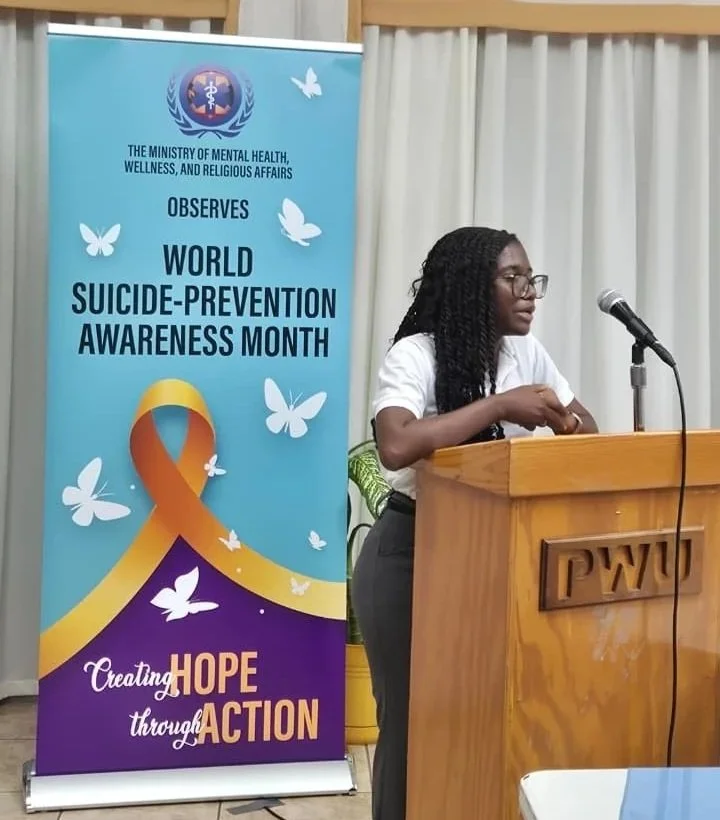
Zadie Barry, featured in the blog, speaking at a national World Suicide Prevention Awareness Month event
Zadie Barryl, age 23, from the parish of St. Andrew shared: “Participating in the focus group was important to have my perspectives, thoughts and ideas shared directly from the youth experience rather than having others speak for me. I hope that actionable change comes about in the form of laws and policies, leading to a better future for mental healthcare”. These insights translated into clear, actionable priorities for Grenada’s forthcoming national suicide prevention plan.
Several key themes stood out. First, youth consistently highlighted stigma and the lack of mental health understanding among adults. In response, one of the major recommendations was to institutionalize parish-level mental health education for parents, teachers, faith leaders, youth leaders, and community elders, so that suicide is addressed as a public health issue and not a source of silence or shame. Second, the focus groups made clear that young people need stronger mental health support within schools. Participants described teachers and principals as common first points of disclosure, but noted that many lack the training, time, or systems needed to respond well. This informed recommendations for regular access to trained mental health personnel in schools, stronger referral pathways, and social-emotional learning beginning at the primary school level.
Third, young people spoke about barriers to accessing care, especially in rural communities and in Carriacou. Geographic isolation, lack of confidential support, and confusion about where to turn all emerged as significant concerns. In response, the recommendations called for expanding the use of medical stations as community mental health access points, developing a national suicide prevention helpline, and creating youth-friendly referral pathways that clearly show where support can be found.
Another critical recommendation emphasized the importance of early intervention to address distress before it escalates into crisis, particularly in the context of climate-related stress. Youth in Carriacou and other rural areas described ongoing fear, displacement, bullying, and untreated trauma following Hurricane Beryl. This reinforced the need to integrate climate-related mental health and long-term trauma support into suicide prevention and disaster recovery strategies in youth-led spaces, schools, and family initiatives.
We are most proud of the fact that the youth focus groups did not settle for only identifying problems. They also pointed toward solutions rooted in dignity, connection, and participation.
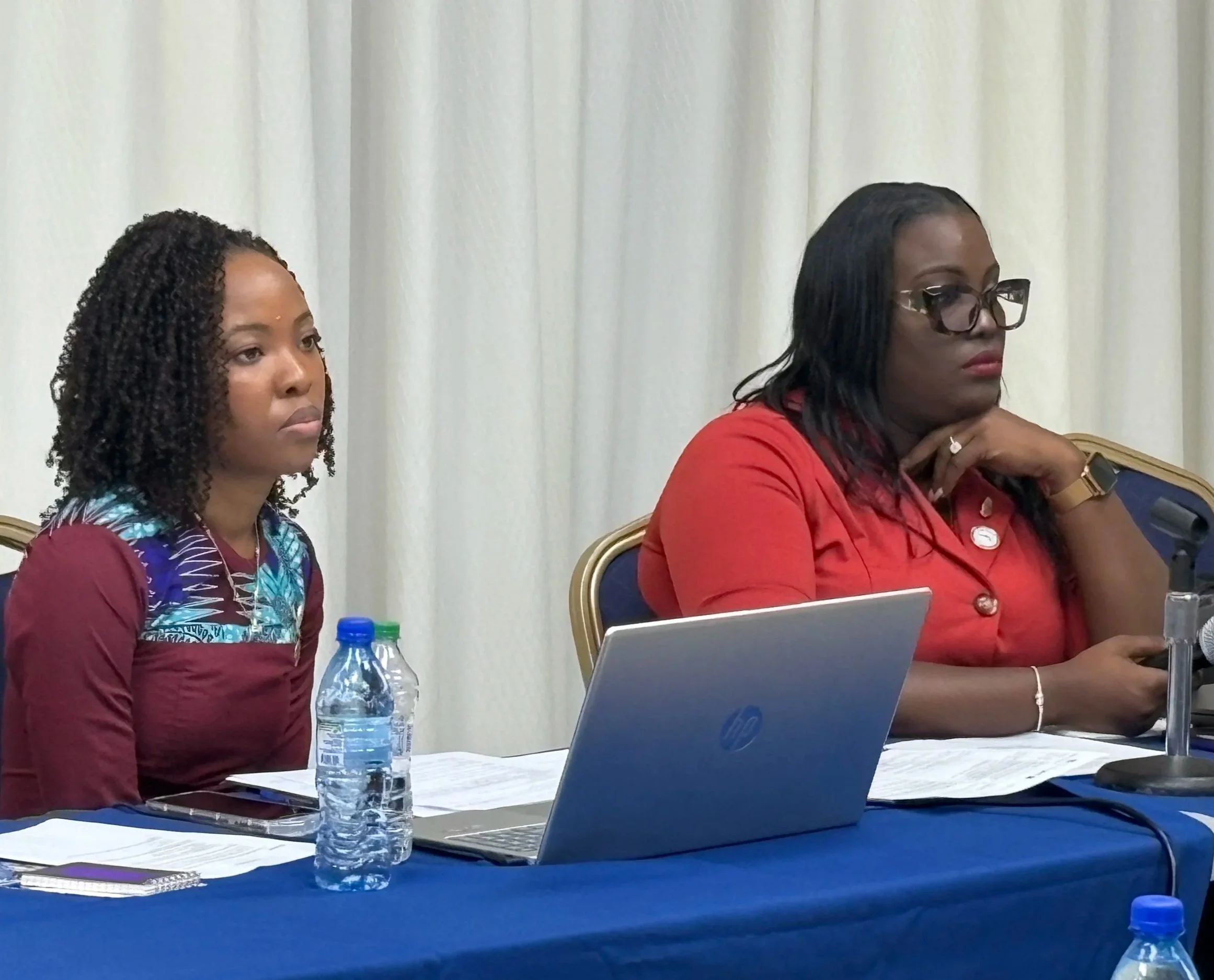
Desarie Nicholas and The Honourable Seville Francis at the National Consultations on Suicide Decriminalisation in January 2025
They called for sustaining youth engagement in monitoring and reviewing the suicide prevention plan in it’s post-implementation phase to reflect a broader principle: Young people must not only be consulted, but also included in shaping the systems meant to support them. Together, these perspectives pointed to concrete areas where systems must evolve to better support young people.
Jonathan Mitchell, age 24 of the parish of St. George said, “Participating in the focus group mattered to me because it gave space to shape a practical, community driven approach to suicide prevention. As a facilitator, I wanted to ensure voices were heard and translated into action and I hope it leads to stronger awareness, earlier support, and real systems that help people before they reach a crisis.”
The implications of this work extend beyond Grenada. The findings demonstrate why youth-informed, cross-sector mental health planning is essential in small island contexts, where stigma, service gaps, and the impacts of climate vulnerability can intersect in particularly acute ways. Grenada’s joint work with UNICEF ECA offers an important example of how governments and civil society can collaborate to translate youth voices into practical policy recommendations.
For CariCope, this work reflects a core belief: effective suicide prevention must be community-based, interministerial, and responsive to the realities young people across the Caribbean are living with everyday. We are encouraged by the opportunity to support Grenada in this process and hopeful that this model of youth-informed policy development can continue to inform mental health and suicide prevention efforts across the Caribbean.
A full list of the recommendations developed from the youth consultations can be accessed here.
By Desarie Nicholas, LCSW
Founder & President | CariCope Wellness Alliance
Co-Chair | Caribbean Coalition for the Decriminalisation of Suicide