Child & Youth Working Group Takeover
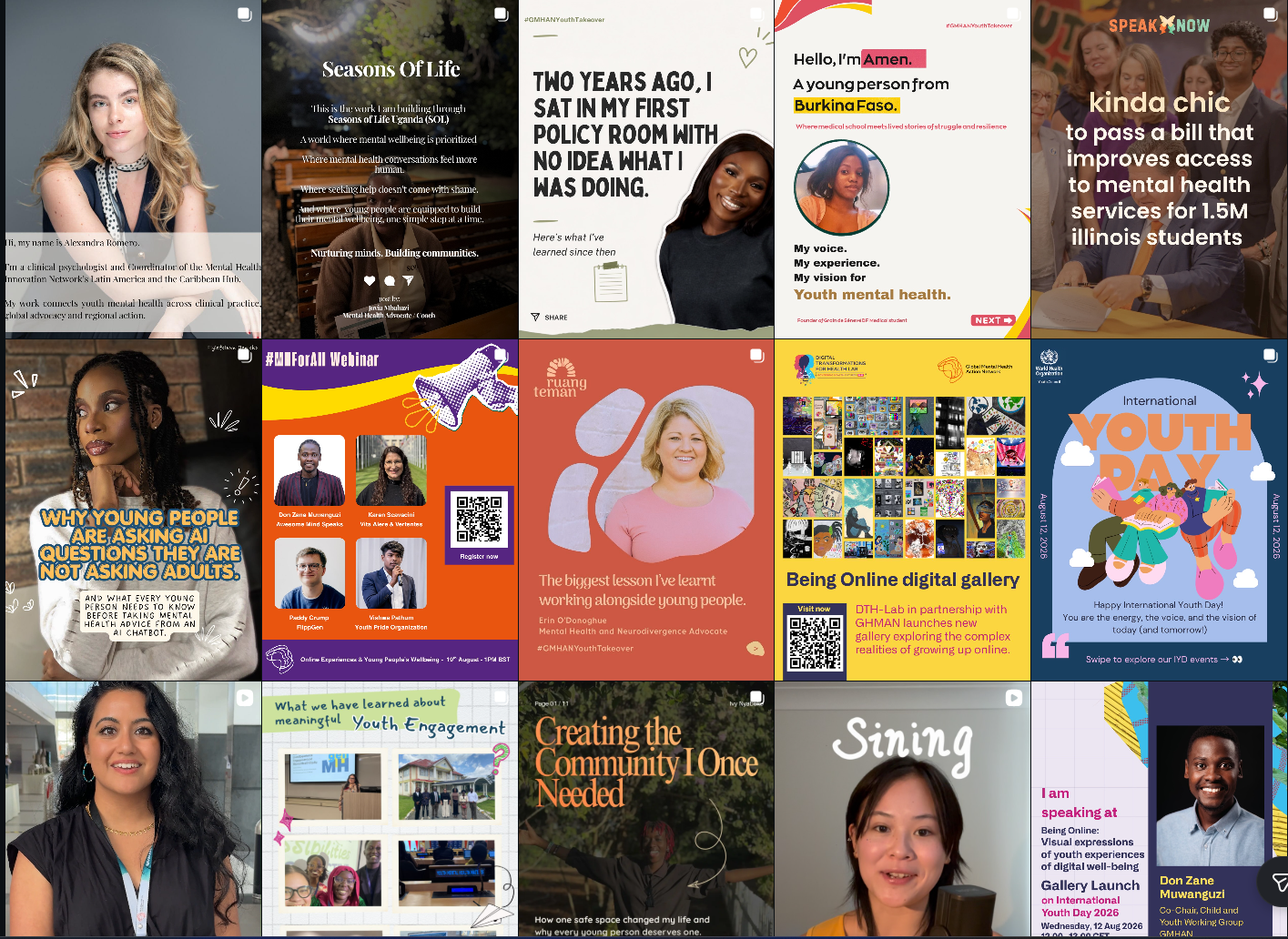
Throughout August 2026, the Child & Youth Working Group—one of our largest and most vibrant membership networks—officially took over GMHAN’s social media channels!
Over 30 inspiring young leaders, advocates, and creators from around the globe led the conversation, sharing their lived experiences, hosting global discussions, and showcasing innovative approaches to youth mental health.
Explore the featured sessions, gallery showcases, and key campaign takeaways below
〰️
Over 500 young people reached
〰️
Explore the featured sessions, gallery showcases, and key campaign takeaways below 〰️ Over 500 young people reached 〰️
Message from the Child and Youth Co-chairs
When we first imagined this Youth Takeover, we didn't want another campaign about young people. We wanted to create something with young people—a space where lived experience, creativity, culture and advocacycould sit side by side. Over August, that vision became real. We featured ~30 young advocates from across Africa, Asia, Latin America, Europe and beyond, who shared stories of burnout, belonging, peer support, Indigenous knowledge, AI, humanitarian response, climate grief, poetry and hope—each in their own voice, on their own terms.
As co-chairs, we're incredibly proud that this campaign stayed true to its original intention: making mental health advocacy feel more accessible, more representative, and more human. None of it would have been possible without every contributor who trusted us with their story, every partner who collaborated so generously, and every member of the GMHAN community who listened, shared, and showed up.
Youth leadership isn't a special event in August; it's something global mental health must continue to invest in, every day.
Online Experiences and Young People's Wellbeing
Digital platforms shape how young people learn, connect, and find support. But between uplifting communities and toxic content, how do we build online spaces that actually prioritize youth mental health?
Governments have mostly responded by trying to limit access, but young people are asking for something different and more precise. What happens when we stop asking how to protect young people from the internet, and start asking how to build one that works for them? In this webinar, we bring together young advocates, researchers, and practitioners to explore what the evidence supports, what young people are calling for, and what advocates can do next.
Watch this #MHForAll session featuring global experts: Paddy Crump (FlippGen, UK), Vishwa Pathum (Youth Pride Organisation, Sri Lanka), Karen Scavacini (Vita Alere & Vertentes, Brazil), moderated by Don Zane Muwanguzi (Awesome Mind Speaks, Uganda), as they unpack how to measure digital impact and co-design platforms that protect—rather than exploit—young users.
a. Webinar
Explore our comprehensive Need2Know briefing on Online Youth Wellbeing for global insights on digital safety, platform impact, and youth-centered design.
Key Insights: Key metrics, research findings, and policy recommendations.
Global Context: Perspectives from mental health advocates across diverse regions.
b. Need2Know
This was made possible through the support of Pinterest
Being Online: A Visual Journey
Experience youth digital life through a new lens. Developed in collaboration with the GMHAN Child & Youth Working Group and the DTH-Lab, The Being Online: Digital Gallery spotlights young people’s creative reflections on navigating, learning, and socializing in our interconnected world.
Watch our recorded Knowledge Exchange Session to discover what these creative expressions reveal about digital wellbeing, the determinants of health, and how to build safer, healthier online environments for current and future generations.
Peer Support in Action: A Youth-Led Model
How can young people support each other in meaningful, safe ways? In this session, Teenergizer shares their practical approach to building a youth-led peer support model for mental health across Eastern Europe and Central Asia (EECA).
Discover actionable strategies on training, supervision, and safeguarding that deliver accessible mental health support to vulnerable youth—while providing early-career professionals hands-on experience in the field.
Key Takeaways:
Practical frameworks for youth-led peer support, supervision, and safeguarding
Strategies to engage young mental health professionals early in their careers
Adaptable ideas to launch peer support models in your own community
Investing in What Makes Young People Thrive
Youth mental health cannot be solved by emergency response alone. In response to recent insights from the Pinterest Impact Fund, the GMHAN Child & Youth Working Group reflects on what it truly takes to move from crisis management to sustainable well-being:
Centering Joy & Belonging: Non-clinical spaces—art, movement, and peer connections—are vital interventions that build long-term resilience.
Championing Trust-Based Funding: We applaud funders like Pinterest who are modeling flexible, community-centered giving for grassroots, youth-led organizations.
Investing in Ecosystems: Platforms, donors, and policymakers must go beyond basic safety standards to actively foster environments where youth can flourish.
Youth Inputs Shape OHCHR Human Rights Report
Under UN Human Rights Council resolution 57/30, the OHCHR consulted with youth organizations worldwide to study how mental health challenges affect young people's fundamental human rights. Capturing the views of approximately 4,000 young people across all regions, the study reinforces that youth mental health is deeply intertwined with the ability to enjoy basic human rights.
We are proud that members of our Child & Youth Working Group contributed directly to this process, ensuring grassroots youth perspectives inform global human rights frameworks and policy.
Takeover Reflections
“I wish more people understood that youth mental health struggles are deeply tied to real-world economic, social, and digital environments—not just personal weakness or clinical conditions.”
— Dhara, India
“What gives me hope is seeing global leaders and organizations begin to genuinely prioritize young people’s mental wellbeing rather than just talking about it, but listening and funding it. ”
— Comfort, Nigeria
“The future of youth mental health sould not only include young people but should also be shaped by them”
— Alexandra, Chile
“I wish more people understood that youth mental health is not a conversation about young people's perceived lack of resilience in the face of life's challenges”
— Fiyinfoluwa, Nigeria
“We need climate-responsive mental health support—from trauma-informed care after disasters to schools and universities where young people can seek help without stigma. No young person should have to turn to search engines because they're too afraid to ask for help.”
— Kezang, Bhutan
“To better support young people's mental health, I would advocate for comprehensive mental health education in schools, ensuring students have access to resources, open conversations, and support network”
— Mapaseka
“I feel optimistic about the future of youth mental health when I witness young people from all over the world speaking openly and unapologetically about mental illness and taking initiative to drive change in their regions, across different sectors and in collaboration with one another. ”
— Sonali, Australia