
#MHForAll Webinar: Lived Experiences Heard - Real Voices, Real Change
This year's World Mental Health Day theme resonates deeply with many in our community. To mark the occasion, the World Health Organization (WHO), World Federation for Mental Health (WFMH), United for Global Mental Health (UnitedGMH) and the Global Mental Health Action Network (GMHAN) hosted a special webinar with members of GMHAN’s Deinstitutionalisation Expert by Experience Action Group (DI EEAG), focusing on the theme “Lived Experiences Heard: Real Voices, Real Change."
Throughout the webinar, panellists spoke of the importance of meaningfully engaging people with lived experience across mental health policy and practice. The WHO launched its new Deinstitutionalisation (DI) Guide, co-produced with experts by experience, and speakers explored strategies to establish rights-based mental health systems, elevate care quality, and ensure leadership by individuals with lived experience of institutional care.
Expert Panellists:
Grace Gatera, DI EEAG Co-Chair & Independent Lived Experience Consultant, Rwanda
Sabine Bährer-Kohler, World Federation for Mental Health, Germany
Anto Agus Sugianto, Aves Mental Health Board & DI EEAG member, Indonesia
Kerri Butler, Take Notice & DI EEAG member, New Zealand
Dr Mark van Ommeren, WHO, Switzerland
Dr Roberto Mezzina, World Federation for Mental Health, Italy
Ali Hasnain, UnitedGMH, Pakistan
Dr Aiysha Malik, WHO, Switzerland
The first panel discussion emphasised that lived experience must be recognised as an equal form of expertise alongside clinical, legal, and research perspectives, offering vital insights across all phases of care, including institutional settings. Anto, Kerri and Ali highlighted the necessity of moving beyond tokenistic story-sharing toward true co-designing of policies, setting agendas, and participating in decision-making from inception. Examples such as the development of the Care Not Custody campaign and Pakistan's national policy development demonstrate the power of creating formal mechanisms for lived experience leadership within advisory groups.
“The Care Not Custody campaign… is about putting an end to deinstitutionalisation and moving towards community-based care, but crucially, it is about putting experts of experience at the heart of mental health policy reform.” — Ali Hasnain, United for Global Mental Health
Our speakers noted that effective co-design relies on strong relational practices:
Investing time to build long-term trust
Creating safe and supportive environments
Closing feedback loops so participants see how their contributions are implemented
"To me, it means authenticity ... being part of driving change is a part of healing for so many of us, particularly when we've experienced system harm." — Kerri Butler, Take Notice
Download WHO's DI Guide
•
Download WHO's DI Guide •
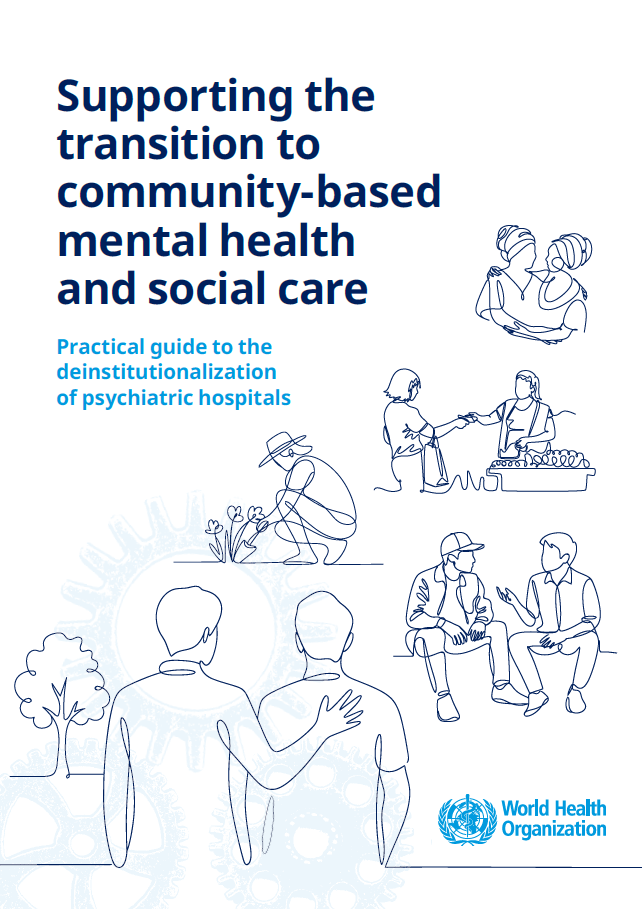
The second panel detailed the newly released WHO practical guide on DI, which focuses on transitioning adults from long-term psychiatric hospital stays exceeding six months into community-based care, housing, and social support. The guide outlines three main action areas:
reducing new admissions and shortening stays (the front door)
improving hospital care while eliminating human rights violations and coercion (the inside)
enabling discharge while building robust community alternatives (the exit door).
Dr Mark and Dr Roberto underscored that over half of mental health budgets in many countries remain locked in long-stay institutions, depriving community services of crucial resources. Central to successful DI implementation is the leadership of individuals with lived experience of institutional care in defining problems, setting priorities, designing alternatives, and monitoring progress.
Advocates and organisations are urged to drive bottom-up advocacy and leverage local WHO country offices to initiate national DI policy dialogues.
“Alliances between professionals, patients, carers and the community are very important toward the whole liberation process that changes thinking and practice.” - Dr Roberto Mezzina, WFMH
Hear Dr Roberto's remarks outlining what it takes to move toward an approach of “care, not custody.”
Recognising that no single group holds all the answers, Dr Aiysha shared WHO’s commitment to listening to feedback, learning from past challenges, and co-creating guidance with people with lived experience to support governments and mental health professionals in making meaningful engagement standard practice across policy, research and service delivery.
“I'm hoping you will not give up. I'm hoping that you will be persistent in your advocacy. Advocacy is about creating change. And usually it takes time. But I'm confident that we can all make a change together.” - Dr Mark van Ommeren, WHO
Replay the full webinar
•
Replay the full webinar •
To ensure lived experience voices are heard and drive real change, we must…
Dr Aiysha: Make sure the people listening are the people who can listen, collaborate and work together.
Ali: Start with our own circles and be allies to people with lived experience and create opportunities for them to meaningfully engage.
Anton: Work together as equal partners; governments, professionals, and lived experience communities must share decision-making power, invest in leadership and capacity-building and co-design policies and services. Together, let us turn meaningful participation into measurable action and lasting change.
Kerri: Have more than just a seat at the table. We need to be part of co-designing what's on the menu and who else needs to be at the table.
Dr Mark: Move from managing people in psychiatric hospitals to listening to them and supporting people through community-based care.
Veronica Cho, GMHAN’s DI EEAG Co-Chair, reflects on the WHO’s DI Guide launch and shares the importance of bridging siloes and adopting a multi-stakeholder and multi-sectoral approach to support the effective transition from long-stay institutions to community care.
Learn more about the DI EEAG here.
Join the Allies of DI Working Group here.
Learn more about the Care Not Custody campaign
•
Learn more about the Care Not Custody campaign •
Knowledge Exchange Sessions: Lived Experience Learning & Action Initiative
Knowledge Exchange Sessions (KES) are spaces designed to build capacity for advocacy and facilitate open conversation. Experts from across the field will share research and practical best practices on how lived experience is understood, valued, and translated into meaningful participation.
Who should attend? These sessions are open to the public! They provide an excellent entry point for advocates and mental health champions to learn about the decentralisation of power.
Register for our five upcoming sessions below:
Session 1: Understanding Lived Experience – Link
Session 2: Demystifying UN Processes - New Guide Launch – Link
Session 3:What Does Lived Experience Bring to the Table? – Link
Session 4: What Does Meaningful Participation Mean, and how can we put it into practice? – Link
Session 5: Building Lived Experience Leadership and Collective Action – Link